Crook’d Finger – Aft !

Tuesday, 17 March 2009

I’ll bet you thought C. Reider couldn’t groove.

I guess I wouldn’t blame you… in his twenty years of recording music he’s put out a lot of conceptual experimental musique concréte, quietnoise proto-ambient and growling electronic beatfields.

But, listen:
around the turn of the century, he quietly donned a superhero name “Crook’d Finger” and released a few recordings of pure thumping pop-techno bliss, replete with subtle humorous samples and musical references to his own backcatalog.

The recordings garnered much acclaim, but have been unavailable for most of the decade.

Vuzh Music is happy to re-release the first Crook’d Finger EP “AFT”.


Originally released in a super special CDr edition (with white faux-fur covering!) in 1999!
Now available, free for all-comers.

More soon!

Also check out C. Reider on Last.FM, or just visit Vuzh Music for the netlabel’s fine roster of free music by C. Reider and friends.


NTNS radio tonight

Friday, 13 March 2009

If you happen to be up during the middle of the night tonight, (I’m being USA-centric with that statement, I know!) you might tune in to the Stillstream Radio station.

The program NTNS (Not the Normal Shit) is going to be featuring the second installment of the Electret Quintet.

The program starts at 1 AM mountain time, 2 AM Central Standard time.

As for me, I’m going to sleep through it and catch the archival recording later, but hey, I don’t know your sleeping habits. Statistically, there have got to be a few vampires that read this blog, so if one of you is reading this now, make plans to tune in tonight!


abandon

Tuesday, 10 March 2009

The massive re-releasing blitz of 2009 continues!
the next up is “abandon” from 1998.

I’m excited to finally set this recording free, it has been released on cassette, and later on CDr, and now finally it can be heard directly on-line, via 256 kbps VBR mp3 or with the streaming player on the page.

The recording is called “abandon”, it is being released now as a C. Reider release, although at one time it was credited to Luster. I’ve decided to put that identity to rest… it makes more sense to have this work credited to my name.

There is massive online documentation about this particular recording on its release page, so I don’t think there’s much more I have to say about this recording. It’s still one of my personal favorites from my discography.

One of the things about this album for me is that it was a huge period of artistic growth. I learned more by doing this album than maybe from any other single project. I can still listen to some of the edits that would be easy for me now, and remember how difficult they were for me then! (Especially since I was using primitive entry-level digital recording with wonky, ineffective editing capabilities (the Roland VS-880)).

Go check it out:
http://www.vuzhmusic.com/releases/abandon.html

After you’ve given it a listen, if you’re curious about it, read the recording notes under the player / download link. If you look closely you’ll find a link to some special stuff, including something I haven’t officially announced as being released yet!


Surprises

Monday, 9 March 2009

My creative work precedes my mixdown / mastering work by a large gap of time, normally.

I’ve recently begun mixing and mastering for the Electret Quintet part 3, work which was composed and assembled in March 2008.

After a working through a few passes at a mixdown over the last few weeks, today I found — nested in the folder for one of the tracks to appear on the third part of this project — a folder titled ‘alt’, which contained a radical remix of that track… I haven’t heard this mix in over a year, and I’d completely forgotten about it! Pretty exciting discovery, for my part. The downside is that adding this new part in will add another couple of minutes to the total length, and I was already thinking it was reaching the limit of lengthiness. The first two tracks alone have a longer duration than the entirety of “The Electret Quintet part 2”.

It’s funny to me that the creative side of my psyche works quickly enough that I can record something and completely forget that it even exists. I wonder how much stuff I’ve created and then misplaced forever?

Didn’t the Residents record something that they intended to have released only once they’d forgotten they’d ever recorded it? That’s a good m.o., IMO.


cr/io on Last.FM

Sunday, 8 March 2009

Those of you whom enjoy using the Last.FM service ought to be happy to know that I’ve added my collaboration with the Implicit Order to their stream-able library.

C. Reider / The Implicit Order @ Last.FM

While you’re there, you could also listen to some C. Reider and Drone Forest.


NQN details, part 11

Monday, 2 March 2009

The final track on ne quid nimis is “in a red time”.

This track was originally recorded as part of an intended collaboration with a guy, a project that did not end up working out.

The song starts off with a very distorted and feedback-laden vocal, courtesy of the Zoom 9002. This gives way to a steady drone which was done by singing a drone into a mic run through pitch shifting, delay and distortion. There’s a guitar part which is pretty stark and spare, and a percussion part, which was made by recording an aluminum soda can wired up with a contact mic. I might have used a pencil or something to strike it, I don’t remember.

I thought at the time I assembled this collection of music that this was the most “ambient” of the tracks on this ‘diary of tentative ambient drafts’. The whole collection was meant as a statement about ambient from the perspective of an eccentric hometaper, and it was probably not by chance that the track I felt was most accessible to a fan of ambient occurred after all kinds of noisy experimentation, including a minute and twenty seconds of distorted noisestuff at the beginning of this track. I never thought things should be easy, and I still don’t.


NQN details, part 10

Saturday, 28 February 2009

The ninth song on ne quid nimis is “the hypnogog”.

This track was recorded for the pair of noise compilations titled “Weeping Eye of God / Creeping Eve of Dog” which featured contributions from Crawl Unit and Richard Ramirez among others.

I didn’t have much appreciation for noise music back in the early 90s. What really bothered me about the style was that from what I could see, a lot of artists were doing noise along with some silly, aggressive macho posturing, which I’d had quite enough of in heavy metal. I only later really came to appreciate noise as a style with a lot of variation and potential. This song was my idea for what noise could be, while still retaining a sort of calmness.

Sadly, I can’t remember a whole lot about the recording of this particular track… it sounds like the main drone is built upon a bass guitar feedback loop. I listed “fabric” as a sound source, and I think I might be referring to the fabric cover of my amplifier, which I might have rubbed against the surface of the microphone, unfortunately, I can’t remember for certain. The outright noise at the end is a guitar freakout run through a pitch shifter with distortion.

The constant presence in this track is an echoing voice, mixed so as to be a background element. The voice is a set of recorded tapes of a local idiot with a TV talk show named Bob Enyart, Pastor of the Denver Bible Church. My wife and I got great entertainment from watching this guy make a fool of himself on television, spouting his hateful views once a week from behind his moustache and ugly ties… with some nutjob call-ins from wishy-washy liberals who limply challenge him and from backwoods rednecks who (burp) agree with him. Bob has some pretty shocking and backwards views, that homosexuality should be punishable by death, for example. He calls child molesters “homosexual recruitment officers”. Charming guy for sure.


NQN details, part 9

Wednesday, 25 February 2009

The eighth track on ne quid nimis is “dying”.

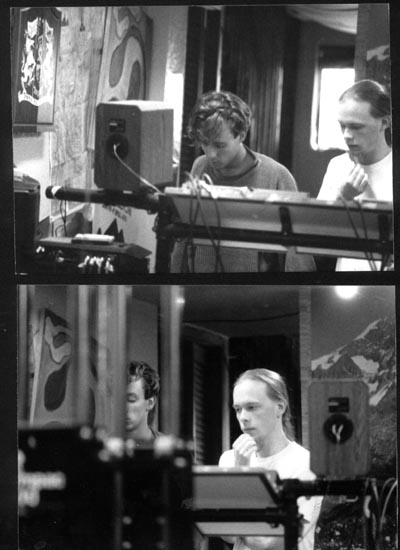
“dying” was recorded by my high school friend Erinn Thorp during the Summer of 1992. He was studying to be a recording engineer in college, and he recorded my first full length tape as a solo artist – not named by Luster – as a project, for credit, during his off time from school. This track was part of that first tape of mine, but this was a pre-mix of the song that didn’t end up on the tape. The final mix of this song had vocals and a smoother delay, with fewer “mistakes”. I like this version better.

This song was directly influenced by Brian Eno. I am embarrassed to admit that in 1992 I had read a whole lot more about Eno’s ideas than I had heard his music. I didn’t have much spare money for buying albums, and there wasn’t such a thing as downloading records at that time. I had read something about Eno’s use of tape loops in “Music for Airports”, and this was my version of that idea.

Frequently, when people hear my music like this, they think I make music by playing synthesizer. This annoys me very much, which is part of the reason I like to list instrumentation, and also is part of the reason that I’m doing this series of blog posts. This is a guitar piece, with a lot of natural sustain, and with a fair, but not outrageous, amount of delay.

I ‘wrote’ the song by choosing six notes to be played on the guitar. The performer takes one of those notes and performs that note and only that note for the length of the performance. The note is played by striking the string with the volume pot all the way down, then fades it in slowly using the volume pot. This gives every note a slow attack, unlike your typical sound on guitar. The note is allowed to sustain, and then followed by a silence at least as long as the note’s duration, but subject to the whim of the performer. Once all six notes/parts had been played and recorded, the recorded material would be fed through a delay unit.

The guitar parts were recorded to 3 tracks of a 4-track tape recorder. Erinn and I played the 6 guitar parts.

Here are a couple of photos of Erinn and I listening to playbacks during this session:


Erinn did me a great favor by recording my music at this time, and I’m very grateful for that… but he also did me a disservice, by keeping the masters of the project for this class. Currently the master tapes are completely lost. Lesson learned: an artist should always own the masters to his work.


NQN details, part 8

Monday, 23 February 2009

On we go with more history about ne quid nimis. The next track in my remembrance of this project is “waiting”.

This track was in some senses a kind of tour de force of my previous work with “destroyed and abused” compact discs. I had been heavily delving into the use of the compact disc as an instrument of sorts for several years. I guess this places me as a contemporary of artists such as Oval, who pioneered the use of digital “glitches”. I do clearly remember the day when I encountered Oval’s album, found out about the praise it was garnering for its futuristic techniques and instantly my heart sunk and I said to myself “Oh shit, I guess this makes me a copycat now.” After that moment I never used another skipping CD as a sound source. I actually couldn’t even bring myself to listen to Oval’s music for a few years, so I guess I felt pretty low about the whole thing, which seems really very silly now, especially since I now know that Oval’s music is about 400 times better than anything that I ever did with skipping CDs.

I remember my best method for getting CDs for experimentation was to go to Wax Trax! and Albums on the Hill in Boulder and ask the people working there if they would give me some of the CDs sent to them as promotional items from record companies. They’d point me to boxes of hundreds of copies of albums and CD singles by bands like Firehose and Roseanne Cash and the Sensible Things. All those copies were probably eventually tossed in the dumpster.

After quite a bit of experimentation with ways to get CDs to skip (sandpaper, X-Acto blade cuts, burning with a lighter) I finally settled on the best method: a water/sugar solution left to dry on the CD surface. If the syrup dried and didn’t give a good skip, I could always wash it off and try again.

I did an awful lot of experimentation with this technique, and finally arrived on a method to render these sounds into a rather calming, throbbing sound field which I was really proud of at the time. Somehow, out of the context of the time, I’m personally left a little cold by the whole thing, which is a little sad.

One of the nicer compliments anyone has given me was about this song, from John Gore of Kirchenkampf, who said back when this album was originally released on cassette by AudioFile Tapes, that it was the sound of the future. As ironic as that feels now, I still warm at the compliment.

Within just this last week, I was looking through old cassette tapes and found a compilation on Epitapes called “Death Full of Flowers” – probably from the 1994-1995 time period – and on it was a track credited to C. Reider (odd enough by itself, during this time period, I usually credited my music as Luster). The title of the piece on the tape was “Study in Compact Disk Abuse”. I had completely forgotten about this track. In fact, its appearance on this compilation was the only copy I have of the track. I didn’t even bother to archive a mix of it for my own records, so it’s very rare, indeed. When I listened to it earlier this week, I was surprised to hear an early version of “waiting”. The structure of the piece is all there, so I guess this is a demo version of the song. In case you are interested, here’s the track. I haven’t cleaned it up at all, so beware of tape hiss.

C. Reider – Study in Compact Disk Abuse


NQN details, part 7

Sunday, 22 February 2009

Back to ne quid nimis… the next track is “dreamdroneone”, recorded in March 1994.

This was another track recorded for the Epitapes label. It originally appeared on the compilation “Like Wind or Empty Dreams”, a compilation of dream music featuring an unlikely assemblage of underground luminaries such as Ken Clinger, M. Nomized, Ataraxia, Kirchenkampf, Sebastien Gandera, Bubble Eyes and others.

I sometimes wake up with clear ideas of a technique for a musical composition, or with strong musical theme that stays with me after waking up. One particular day, after waking up from a fitful sleep, I was struck by some of the startling, piercing electronic-like sounds my mind sometimes produces while in hypnogogic/hypnopompic states. This track was a kind of emulation of those mindsounds, coupled with a recording of a drone from a fan that my wife and I would leave running all night long as a kind of white noise generator. I seem to remember that I recorded this directly out of bed, without even pausing to eat breakfast.

The other sounds you hear on this song are skipping CDs (a common sound source for me in the early 90s) and a “re-tuned” music box. Re-tuning of a music box is simply taking the tuned forks off of one music box and putting them on another, so that the box plays “the Danube Waltz”‘s rhythm with the notes from “Twinkle Twinkle Little Star” or something like that. You can force a formerly harmless music box which is programmed to play an inane piece of music to instead play an unidentifiable sound loop. In this track, there are clearly some really dissonant moments coming from the music box. Again, I don’t remember what songs were on the specific music boxes I used at this time.

There was a “dreamdronetwo”, which sat unused for a number of years, and eventually turned up on the catch-all 1998 release “abandon“. It was a strong musical theme from a dream, and I’m pretty sure it was conceived and recorded the day after “dreamdroneone”.

Those were not the only songs that were composed by my dreaming mind, but I don’t remember ever naming any song “dreamdronethree”.


  • News and info about Vuzh Music artists and friends, written by C. Reider
  • Base

  • Elsewhere

  • Categories

  • Archives